 Plays from YouTube when you click
Prader-Willi Syndrome Association UK · December 12, 2018 · 00:54:24 · 275 views
A Prader-Willi trial investigator explains why oxytocin: the main claim
Oxytocin and vasopressin systems are disrupted in Prader-Willi syndrome, early studies were encouraging, and getting the amount right is the main unsolved problem.
One of the more careful talks in the oxytocin set, and a useful record of what researchers hoped before the trial result. It is cautious about doses and honest that studies disagree.
The speaker explains the biological rationale in plain terms: autopsy work showing fewer oxytocin-producing neurons, mouse models in which social behavior improved after oxytocin, and early human studies with mixed results. She says an Australian study in older participants saw worse temper tantrums on oxytocin than on placebo, and says plainly that nobody knows the right amount.
The talk is also a snapshot in time. The pilot she was running reported later: in 23 children and adolescents over 8 weeks, placebo was linked to modest improvement in hyperphagia and repetitive behavior while oxytocin was not. A pooled analysis of three small trials found no effect on hyperphagia or weight.
A Prader-Willi trial investigator explains why oxytocin: what holds up
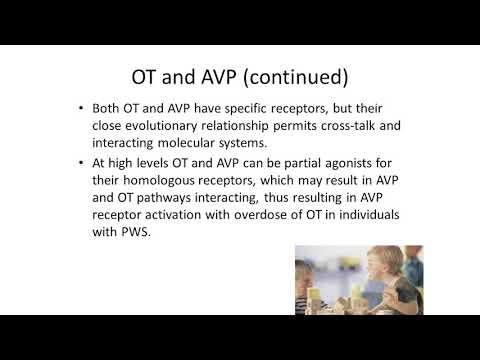
- Says more oxytocin is not better and that too much can move toward anxiety or temper tantrums by acting on a related receptor. The adolescent trial in our records shows that a nasal dose can increase negative interpretations (p=0.019), so a higher dose does not simply amplify a good effect. Source
- Admits that the problem with oxytocin studies is that nobody knows the right amount. She lists limits of earlier work, including studies with a single dose and no placebo group.
- Names the Australian placebo-controlled study that found worse behavior on oxytocin, which is the sort of finding a more promotional speaker would leave out.
- Presents mouse results as mouse results. A knockout model of the syndrome in mice improved socially after oxytocin, which she describes as encouraging for people but not as proof.
A Prader-Willi trial investigator explains why oxytocin: what it skips or gets wrong
- Reports hopeful early findings on sleep and constipation. In the sleep study, oxytocin raised total sleep time and sleep satisfaction in a crossover design, and in the constipation study both placebo and oxytocin improved symptoms. Our records hold no controlled sleep or constipation trial in this condition, and the hyperphagia pilot that followed did not favor oxytocin. Source
- Describes oxytocin as the bonding hormone that raises trust. Replication attempts of healthy-volunteer social effects were largely unsuccessful, and a 2022 review called the evidence for a dedicated social role weak. Source
- Is hopeful about the longer-acting analog carbetocin replacing oxytocin because it is safer for this syndrome. That was a hope in 2018. The meta-analysis of three small oxytocin trials (94 patients) found no effect on hyperphagia (mean difference 0.18) or weight (0.30). Source
- Suggests that a child's oxytocin system is largely set within the first six months and that exposure outside that window may matter. We hold nothing on this, so treat it as a hypothesis from the talk.
A Prader-Willi trial investigator explains why oxytocin: strengths and weak spots
Strengths
- Speaker is the trial investigator and is open about unknowns
- Warns against the more-is-better assumption
- Mentions studies with unfavorable findings
- Answers family questions in plain language
Weak spots
- Predates the final trial result
- Several benefits described come from small or unblinded studies
- Audio is rough in places and the slides are not visible
- Quick to describe oxytocin as the bonding hormone
A Prader-Willi trial investigator explains why oxytocin: our recommendation
Worth watching in full if you are in this community. Pair it with the later pilot result. Do not treat the early sleep or gut findings as established, and ask the treating team before any nasal product is tried in a child.