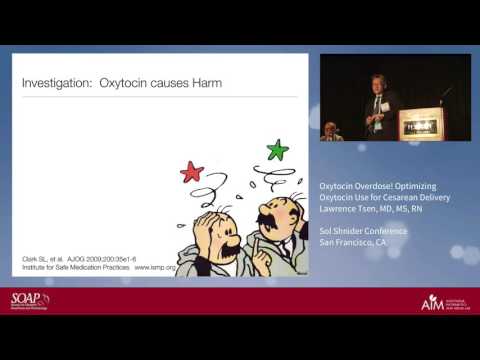
 Plays from YouTube when you click
AnesIllustrated · March 13, 2016 · 25:34 · 5,604 views
An anesthesiologist says cesarean oxytocin is overused: the main claim
Intravenous oxytocin is routinely overgiven at cesarean delivery, the excess causes harm including low blood pressure, and a short timed escalation scheme can replace it.
Verdict: a good talk for the narrow audience it was made for, anesthesia providers on a labor floor, and the wrong video for anyone who searched oxytocin hoping to learn about the love hormone or the nasal spray. Lawrence Tsen argues that hospital oxytocin at cesarean is given in larger amounts than the physiology needs, that the excess lowers blood pressure and blunts the uterus's own response, and that a fixed sequence of small bolus, timed tone check and escalation to other drugs does the same job.
Our evidence set is built around intranasal oxytocin in psychiatric and metabolic research. It holds nothing on intravenous use at cesarean, so we cannot grade the central claim against trials we have. What we can do is check the asides, check the arithmetic, and ask what kind of evidence the talk leans on.
That last question is where I would push back. The case rests on vague guidelines, small physiology studies, and a before-and-after rollout at his own institution. The rollout result is reported as how little drug was used. The talk shows no bleeding or transfusion outcome, so the headline answer, that this is an overdose, is stated with more certainty than the evidence on screen carries.
An anesthesiologist says cesarean oxytocin is overused: what holds up
The unit confusion is real and he explains it well. Clinicians say "half a unit" when the order means half a milli-unit per minute, a thousandfold gap. I redid his arithmetic: at the slow rate, reaching a given total takes about a week, at the fast rate about three hours. That is the most transferable minute in the talk.
He is right that official guidance is loose. By his tour, one major obstetrics textbook gives no guidance on speed or frequency, other texts give wide ranges, and national societies disagree with each other. I did not check each guideline against its source, and the talk is from 2016, so current documents may differ.
On blood pressure he cites a Norwegian arterial-line group in which every woman crossed a 20% systolic drop after the first bolus (mean fall 31%), and again after a second (mean 23%). The finding that a drop is common is credible. He also notes that the 20% cutoff makes this look universal, which is a fair reading of a sensitive definition.
He is plain about the limits of the alternatives. He says carbetocin is not FDA-approved in the United States and was less potent in the Toronto lab work, and that misoprostol for uterine tone is off-label with a large trial still pending. That is calibrated, and unusual for a talk promoting its own scheme.
An anesthesiologist says cesarean oxytocin is overused: what it skips or gets wrong
The love-hormone aside states as fact that seeing an attractive person gives you a spike of oxytocin. Nothing in our record supports that. A 2022 review of the claim that oxytocin is a social neuropeptide concluded the evidence is weak, and a 2021 meta-analysis found peripheral oxytocin level was not significantly associated with attachment. A 2017 meta-analysis of 17 studies found blood and brain levels barely correlated at baseline (r = 0.08).
SourceThe "overdose" verdict is delivered without qualification, but the support is a mix: dose-finding studies that estimate the least drug needed in small groups, hemodynamic measurements, and legal records of rare maternal deaths. The talk presents no randomized comparison of patient outcomes such as hemorrhage.
His own rollout is described as proof the scheme worked. The outcome reported is that cesarean cases used a small total amount of oxytocin by the time the patient left the room. That is a measure of drug used, not of blood loss, transfusion or hemorrhage, and no control group is described.
Higher blood loss after heavier oxytocin use in induced and augmented labors is read as receptor desensitization, backed by a rat study and a cell-exposure experiment. Those are laboratory findings. He does not mention the obvious alternative: longer, harder labors both get more oxytocin and bleed more.
The UK maternal deaths are tied to a single rapid bolus, then four mechanisms are offered (cardiac receptors, atrial natriuretic peptide and nitric oxide release, the preservative). No case counts are given, and a plausible mechanism is not evidence that it caused those deaths.
The talk never says the route matters. This is hospital intravenous use. Oxytocin is also studied as a nasal spray, and in cynomolgus monkeys a dry-powder nasal form reached about 12% of the exposure of an intramuscular injection. Nothing in the video transfers to nasal use.
Source
An anesthesiologist says cesarean oxytocin is overused: strengths and weak spots
Strengths
- Makes the units versus milli-units trap concrete and checkable
- Admits the guideline literature is vague rather than pretending consensus
- Flags unapproved and off-label agents plainly
- A fast 25 minutes with a clear three-part argument
Weak spots
- One-sided advocacy for the speaker's own scheme
- No patient outcome data shown for the rollout
- Auto-captions are garbled, so citations are hard to trace
- The love-hormone aside is unsupported and the humor about nationalities will grate
An anesthesiologist says cesarean oxytocin is overused: our recommendation
Skim if you work in obstetric anesthesia: the unit-confusion section and the hypotension section carry the value, and the rest is slides on his own scheme. Skip it if you came for the love hormone or nasal oxytocin. For that, read the 2021 NEJM autism trial (290 children, difference from placebo -0.2 on the primary outcome). For the clinical claim, read the published rollout study he mentions and current obstetric society guidance. Nobody outside a delivery team should take amounts from this video; those decisions belong to the anesthesiologist and obstetrician at the bedside.